

Mental Health Commission

The Mental Health Commission (Commission) is the agency principally responsible for assisting the Minister for Health and Mental Health in the administration of the Mental Health Act 2014 and the Alcohol and Other Drugs Act 1974.
This page provides information about key legislation relevant to mental health and alcohol and other drug services in Western Australia, including current reform activities and supporting resources.
Statutory Review of the Mental Health Act 2014
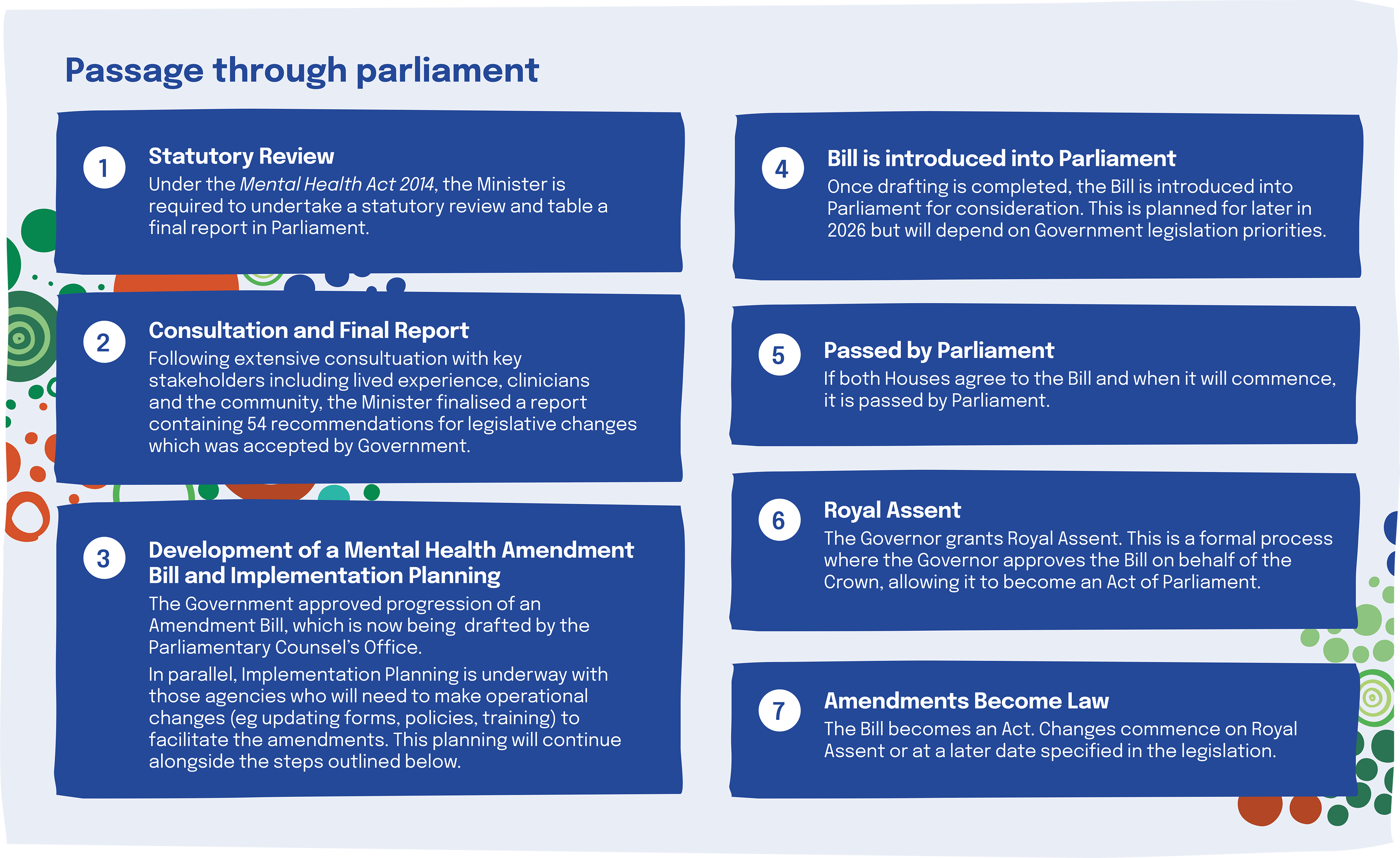
The Mental Health Act 2014 required a statutory review of its operation and effectiveness.
The Commission undertook the review on behalf of the Minister for Mental Health, including an extensive public consultation period which is described in the Final Report of the Statutory Review of the Mental Health Act 2014.
The review concluded in April 2024 when the Minister tabled the:
- Final Report of the Statutory Review of the Mental Health Act 2014 (Final Report)
- Government Response to the Report on the Statutory Review of the Mental Health Act 2014.
The State Government accepted all 54 recommendations for legislative reform in principle.
Development of a Mental Health Amendment Bill
The Commission is progressing amendments to the Mental Health Act 2014 to implement the recommendations endorsed by the State Government following the Statutory Review. This will be known as the Mental Health Amendment Bill 2026.
The proposed legislative changes in the Mental Health Amendment Bill 2026 are expected to:
- strengthen consumer rights
- improve access to culturally safe care for Aboriginal and Torres Strait Islander people
- enhance support for families, carers and personal support persons
- streamline operational processes and administrative requirements.
Implementation Planning
- Planning is underway to ensure agencies directly responsible for the implementation of the Mental Health Act 2014 are prepared for the proposed legislative changes.
- A governance framework has been established to guide the drafting of amendments, implementation planning and stakeholder engagement to support a coordinated process.
- This work is being informed by an Implementation Oversight Working Group of agencies with direct responsibilities for the Mental Health Act’s implementation including representatives from the Commission, Department of Health, Health Service Providers, Mental Health Advocacy Service, Mental Health Tribunal, and the Office of the Chief Psychiatrist.
- The Commission is also progressing projects to support the compliance and operation of the Mental Health Act 2014, including the development of new education, training and information resources to reflect more contemporary practice.
- These compliance initiatives will consider opportunities for engagement with relevant stakeholders, including consumers, carers, service providers, clinicians and Aboriginal stakeholders, as this work progresses through the development and implementation planning stages.
The Criminal Law (Mental Impairment) Act 2023
The Criminal Law (Mental Impairment) Act 2023 provides the legal framework for people who are:
- unfit to stand trial or
- found not guilty by reason of mental impairment.
The Criminal Law (Mental Impairment) Act 2023 commenced on 1 September 2024 and replaced the Criminal Law (Mentally Impaired Accused) Act 1996.
The Criminal Law (Mental Impairment) Act 2023 includes provisions relating to:
- special criminal proceedings for accused persons who are unfit to stand trial
- findings of not guilty by reason of mental impairment
- supervision and management of supervised persons
- decision-making by the Mental Impairment Review Tribunal
- pathways to support safe community reintegration.
The Criminal Law (Mental Impairment) Act 2023 affects:
- people subject to supervision orders under the Act
- families, carers and support persons
- mental health professionals
- legal practitioners
- courts and tribunals
- justice, health and community service agencies.
Resources and guidance
The Commission works collaboratively with government agencies and service providers to support implementation of the Criminal Law (Mental Impairment) Act 2023 and to provide information and resources for consumers, carers and clinicians.
Related Legislation
The Commission’s work intersects with a range of other Western Australian legislation, including:
- Carers Recognition Act 2004
- The Criminal Law (Mental Impairment) Act 2023
- Disability Services Act 1993
- Equal Opportunity Act 1984
- Freedom of Information Act 1992
- Guardianship and Administration Act 1990
- Health and Disability Services (Complaints) Act 1995
- Health Services Act 2016
- Workers Compensation and Injury Management Act 2023
- Work Health and Safety Act 2020
Page last updated5 October 2026